
 The Standard Group Plc is a multi-media organization with investments in media
platforms spanning newspaper print
operations, television, radio broadcasting, digital and online services. The
Standard Group is recognized as a
leading multi-media house in Kenya with a key influence in matters of national
and international interest.
The Standard Group Plc is a multi-media organization with investments in media
platforms spanning newspaper print
operations, television, radio broadcasting, digital and online services. The
Standard Group is recognized as a
leading multi-media house in Kenya with a key influence in matters of national
and international interest.


African countries have been asked to invest in generating local data, warning that the continent still relies heavily on foreign-generated evidence to make critical policy and health decisions.
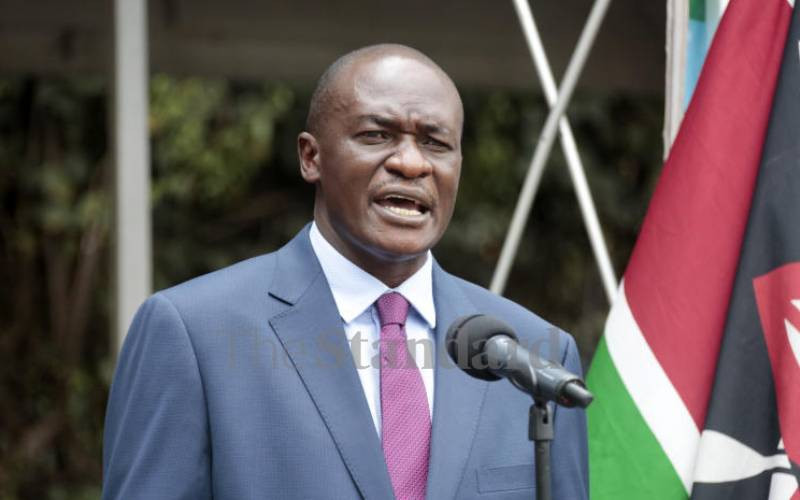
Speaking during the launch of Knowledge Hub at the African Population and Health Research Center (APHRC) in Nairobi, Science, Research and Innovation Principal Secretary Shaukat Abdulrazak said inadequate data remains one of the continent’s greatest challenges.
“Sometimes we formulate policies, even in industries such as pharmaceuticals, using data that was not generated here,” he said.
The Knowledge Hub is part of APHRC’s celebrations marking 25 years of research and policy engagement across Africa.
Prof Abdulrazak described the facility as a strategic investment aimed at strengthening Africa’s ability to generate and apply evidence-based solutions to development challenges.
His remarks come amid growing concern over Africa’s limited contribution to global scientific research despite the continent carrying a significant share of the world’s disease burden, climate vulnerability and development challenges. According to UNESCO, Africa produces only about 1 per cent of global scientific research output despite being home to nearly 18 per cent of the world’s population.
UNESCO data shows Sub-Saharan Africa has only about 90 researchers per one million people compared to the global average of 1,420 researchers per million. North America and Western Europe have more than 4,700 researchers per million people.
“Africa’s transformation will increasingly depend on our ability to generate, interpret and apply evidence to solve complex development challenges. This Knowledge Hub is more than a building; it is a bold statement about the continent’s readiness to shape its own development trajectory through research, innovation and collaboration,” he said.
Research capacity across the continent also remains low. UNESCO data shows Sub-Saharan Africa has only about 90 researchers per one million people compared to the global average of 1,420 researchers per million. North America and Western Europe have more than 4,700 researchers per million people.
Funding remains another major challenge. African countries invest an average of 0.59 percent of GDP into research and development, far below the global average of 1.79 percent, limiting the continent’s ability to build laboratories, innovation hubs and long-term scientific programs.
A 2023 bibliometric analysis on machine learning research in Africa reviewed 2,761 publications from 54 African countries between 1993 and 2021, showing that while research output is growing, it remains unevenly distributed across the continent, with a few countries accounting for the majority of publications.
Prof Abdulrazak said African countries must strengthen their intellectual infrastructure to address emerging issues such as climate change, food insecurity, digital transformation and public health crises.
“Data generation is extremely important, but interpretation of that data is equally vital so that governments can make informed decisions,” he added.
The PS said Africa contributes only a small fraction of global knowledge production, but noted that partnerships and investment in research institutions were helping place the continent on the right path.
“We live in an era where decisions must be guided not merely by assumptions or urgency, but by credible data, vigorous analysis and practical insight,” he said.
Over the last 25 years, APHRC has built a reputation for producing research in public health, education, population studies, urbanisation, climate resilience and data science, while working closely with governments and development partners across sub-Saharan Africa.
The new Knowledge Hub is expected to deepen regional collaboration and increase the accessibility of African-led research and innovation.
Speaking during the event, Dr Catherine Kyobutungi, Executive Director of APHRC, said the facility reflects the institution’s growth and future ambitions.
“This Knowledge Hub is a significant testament to the growth, resilience and maturity of our institution over the past 25 years. It embodies our vision of creating an inclusive platform where ideas converge, partnerships flourish and African solutions are generated to address African problems,” she said.
Dr Kyobutungi added that the center will continue supporting governments, academic institutions and communities with evidence needed to shape development policies.
The government also praised APHRC for supporting Kenya’s Vision 2030, the Bottom-Up Economic Transformation Agenda and the Universal Health Coverage roadmap through research-driven policy recommendations.
Prof Abdulrazak further urged African nations to strengthen the link between science, innovation and policymaking to ensure research translates into meaningful social and economic impact across the continent.









 join
join