
 The Standard Group Plc is a multi-media organization with investments in media
platforms spanning newspaper print
operations, television, radio broadcasting, digital and online services. The
Standard Group is recognized as a
leading multi-media house in Kenya with a key influence in matters of national
and international interest.
The Standard Group Plc is a multi-media organization with investments in media
platforms spanning newspaper print
operations, television, radio broadcasting, digital and online services. The
Standard Group is recognized as a
leading multi-media house in Kenya with a key influence in matters of national
and international interest.

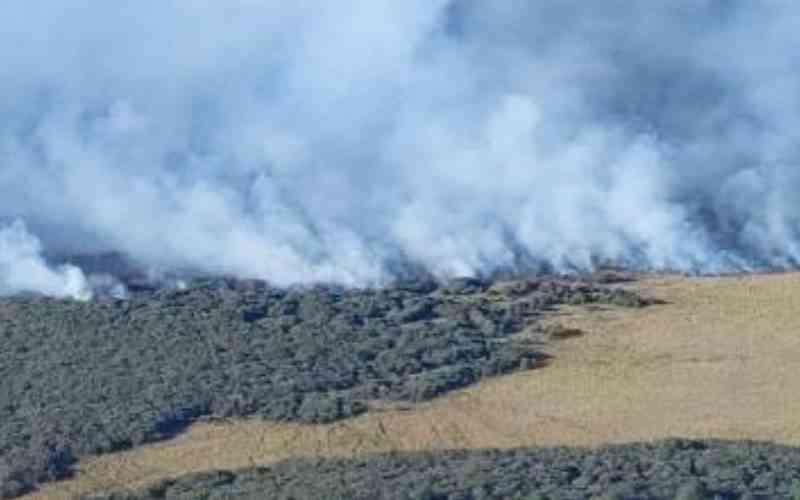
Wildfire destroyed over 15,000 acres of the Aberdare National Park. [File, Standard]
Kenya is losing ground in the fight against wildfires as old policies fail to keep pace with a hotter climate and increasing human activities.
New research has revealed that current fire suppression policies in the country are failing to keep pace with escalating effects of climate change and human encroachment, leaving more than a third of some protected landscapes at extreme risk of burning.
The study, which was published in Fire Ecology in March 2026, analysed two decades of satellite data across key ecosystems, including the Maasai Mara, Tsavo, the Aberdares, and Mt Elgon. The findings reveal that old fire management policies are failing, yet the environment is changing too fast for them.
“The results show that existing fire suppression policies have not adequately addressed increasing wildfires in the protected areas,” the research showed.
The research highlights a difference in how fire behaves across Kenya’s ecosystems. While montane ecosystems like Aberdares and Mt Elgon showed relatively stable fire trends, the savanna ecosystems are experiencing a spike in fire outbreaks.
In the montane forests, the total acreage burned has not increased over the years, but the researchers warn that this statistical stability is worrying.
- Kenya's climate laws mask deep failures as counties struggle with floods, waste
- As climate shifts, malaria gains ground in southern Africa
- Climate shocks strain Kenya's health systems as stakeholders push for resilience and reform
- Leaders call for urgent action to protect oceans against climate change
Keep Reading
“These fires are repeatedly hitting the same high-elevation grasslands and moorlands, the fragile areas that were never meant to burn often. Unlike the savannas, these ecosystems cannot just bounce back because every repeated fire outbreak chips away at the same landscapes that trap and store the water that millions of Kenyans rely on,” said Amos Chege, the lead researcher.
In the Maasai Mara, the research shows that fires are no longer confined to the tail end of the dry season but are breaking out more often, covering more ground, and appearing at odd times of the year that defy historical patterns. They recorded an increasing trend in annual burned areas.
In Tsavo, the findings are different, but also worrying, according to the researchers. Although the total land burned has dropped, this quiet is often broken by huge fires triggered by extreme climate shifts.
“Maasai Mara is experiencing a surge in frequent, unpredictable fires that peak much earlier in the year, while Tsavo has seen an overall decrease in burned acreage. However, Tsavo remains vulnerable to erratic, large-scale fires,” Chege said.
The study found that human activities are the main causes of the fires. It found that while lightning can cause natural fires, fire often escapes from farms bordering protected areas.
It also found that traditional practices like honey harvesting and charcoal burning remain major ignition sources. Illegal activities like poaching have also been linked to fire outbreaks.
For years, Kenya’s strategy has been fire suppression, which entails simply trying to put fires out when they start. However, the research suggests this approach is reactive and inadequate.
“Authorities may be ignoring the need for Integrated Fire Management, a strategy that includes controlled, prescribed burning to reduce dry materials and involves local communities in fire prevention,” Chege said.
He explained that while many people view fires as a tragedy, controlled burning is helpful in controlling intense fire outbreaks.
“Total lack of fires in an ecosystem can lead to a dangerous buildup of dry grass and twigs, which potentially sets the stage for massive, catastrophic blazes in the future. However, when sections are burned in a controlled way to reduce the dry matter, cases of catastrophic wildfires are reduced,” Chege noted.
When these forests and savannas burn, they release a massive amount of carbon that traps more heat in the atmosphere. This carbon makes the air hotter and rainfall more unpredictable, creating the exact dry conditions that invite the next even bigger wildfires.
The researchers are calling for an urgent change in wildfire management and the implementation of a National Fire Management Policy. They also called for the adoption of advanced monitoring tools to create real-time fire susceptibility maps.











 join
join