
 The Standard Group Plc is a multi-media organization with investments in media
platforms spanning newspaper print
operations, television, radio broadcasting, digital and online services. The
Standard Group is recognized as a
leading multi-media house in Kenya with a key influence in matters of national
and international interest.
The Standard Group Plc is a multi-media organization with investments in media
platforms spanning newspaper print
operations, television, radio broadcasting, digital and online services. The
Standard Group is recognized as a
leading multi-media house in Kenya with a key influence in matters of national
and international interest.

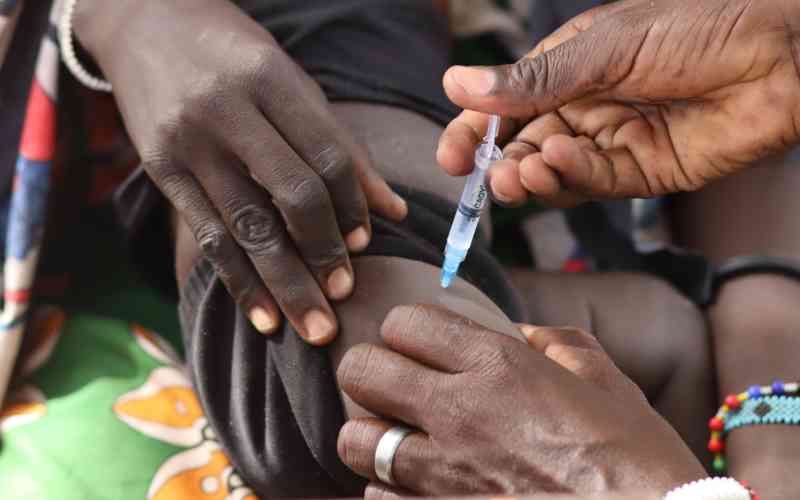
An infant is immunised during the integrated nutritional outreach at Kalapata, Turkana South. [Jacob Musya, Standard]
Kenya is among 12 countries that have benefited from a global push to reach unvaccinated children under five, as the world marks World Immunisation Week.
The countries have benefited from an initiative known as the Big Catch-Up (BCU).
Through the initiative launched in 2023, countries are working to close widening immunisation gaps excerbated by disruptions to health services during the Covid-19 pandemic.
According to Gavi, the Vaccine Alliance, World Health Organisation and UNICEF, the vaccination drive has helped narrow critical immunity gaps across participating countries.
World immunisation week is observed every year in the last week of April, from April 24 to April 30.
Globally, the multi-year campaign reached an estimated 18.3 million children aged between one and five years across 36 countries, administering more than 100 million doses of life-saving vaccines between 2023 and 2025.
Of these, about 12.3 million were 'zero-dose' children, those who had never received a single vaccine, while 15 million had not received a measles vaccine.
The programme also delivered 23 million doses of inactivated polio vaccine (IPV) to un- and under-immunised children.
Implementation of the initiative ended on March 31, 2026, with final data still being compiled.
However, early projections show the programme is on track to meet its target of reaching at least 21 million missed children.
Health agencies caution that while catch-up campaigns are critical in closing gaps, strengthening routine immunisation remains the most effective and sustainable way to protect children and prevent outbreaks.
Beyond pandemic recovery, the initiative focused on addressing vaccine inequality, particularly among children in fragile, conflict-affected and underserved communities.
Globally, millions of children miss essential vaccines before their first birthday, and many are never reached as they grow older.
The 36 countries participating in the BCU programme account for about 60 per cent of all zero-dose children worldwide.
Pandemic-related disruptions worsened the situation, adding millions more children to those already missing routine vaccinations.
For the first time, the programme deliberately targeted older children aged one to five who had missed early immunisation, using routine health systems to identify, screen and vaccinate them.
Countries strengthened systems to track and reach missed children, updated policies on age eligibility, and trained health workers to integrate catch-up vaccination into routine care.
Community engagement and partnerships with civil society also played a key role.
Among the 12 countries including Kenya, Burkina Faso, Democratic People's Republic of Korea, Ethiopia, Madagascar, Mauritania, Niger, Pakistan, Somalia, Togo, Tanzania, and Zambia reported reaching more than 60 per cent of zero-dose children under five who had missed their first dose of the diphtheria, tetanus and pertussis vaccine (DTP1) were reached.
In Ethiopia alone, more than 2.5 million previously unvaccinated children received DTP1, alongside millions of doses of polio and measles vaccines.
Nigeria also recorded significant gains, reaching two million zero-dose children with DTP1 and administering 3.4 million doses of IPV.
While countries received funding from Gavi and technical support from WHO and UNICEF, officials warn that sustaining these gains will require continued investment in routine immunisation systems.
"As the largest-ever international effort to reach missed children with life-saving vaccines, the Big Catch-Up shows what is possible when governments, partners and communities work together," said Sania Nishtar.
Tedros Adhanom Ghebreyesus said the initiative helped reverse one of the most significant setbacks caused by the pandemic - missed childhood vaccinations.
"By protecting children who missed out on vaccinations due to disruptions in health services, the BCU has helped undo one of the pandemic's major negative consequences," he said.
Catherine Russell noted that while progress has been made, millions of children remain unreached.
"We have caught up with some children who missed routine vaccinations during the pandemic, but many more remain out of reach," she said, warning of resurging measles outbreaks.
Despite the gains, challenges in vaccinating all children in Africa and globe remain.
For instance in 2024, an estimated 14.3 million infants globally did not receive a single vaccine through routine immunisation programmes.
Health experts warn that rising birth rates, conflict, displacement, funding constraints and strained health systems continue to hinder progress.
The consequences are already visible, with measles outbreaks increasing worldwide.
About 11 million cases were reported in 2024, with the number of countries experiencing large outbreaks nearly tripling since 2021.
Experts emphasise that while large-scale catch-up campaigns help close gaps, they are resource-intensive and cannot replace routine immunisation.
Timely vaccination, aligned with national schedules, remains the most reliable way to protect children and communities from preventable diseases.
In Kenya, the Ministry of Health runs routine immunisation under the Kenya Expanded Programme on Immunisation (KEPI), targeting diseases such as tuberculosis, polio, diphtheria, whooping cough, tetanus and measles.
However, about 300,000 infants miss critical vaccines each year, even as the government targets to vaccinate at least 1.5 million children annually.
National immunisation coverage currently stands at about 80 per cent, underscoring the need to strengthen routine services and reach underserved populations.






 join
join