
 The Standard Group Plc is a multi-media organization with investments in media
platforms spanning newspaper print
operations, television, radio broadcasting, digital and online services. The
Standard Group is recognized as a
leading multi-media house in Kenya with a key influence in matters of national
and international interest.
The Standard Group Plc is a multi-media organization with investments in media
platforms spanning newspaper print
operations, television, radio broadcasting, digital and online services. The
Standard Group is recognized as a
leading multi-media house in Kenya with a key influence in matters of national
and international interest.


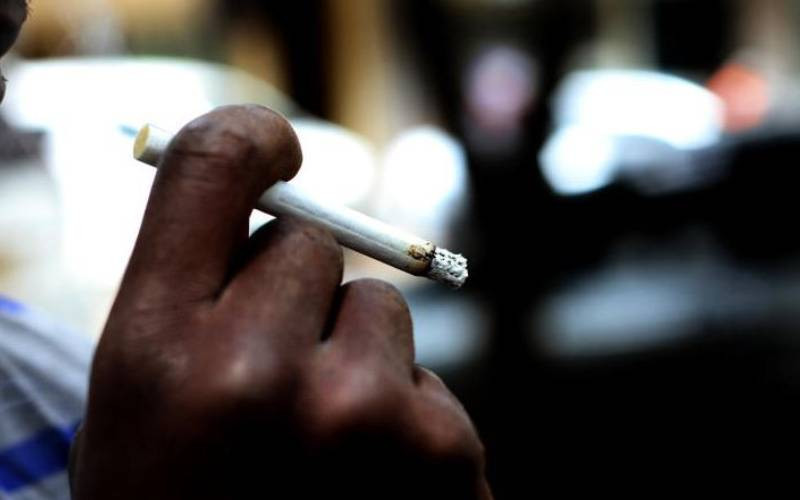
A man puffs a cigarette during the commemorations of World No Tobacco Day at the University of Nairobi on May 31, 2022. [Elvis Ogina, Standard]
MPs and health advocates have raised concerns over tactics applied by the tobacco industry and weak regulations on tobacco and nicotine use.
The tactics they said are pushing more youth into addiction, while increasing cases of Non-Communicable Diseases (NCDs) linked to tobacco and nicotine consumption.
Dr James Nyikal said the scale of the problem facing Kenya is immense, noting that NCDs now account for more than half of hospital admissions.
“The gravity of the challenge facing the country due to tobacco use is huge. NCDs account for over 50 per cent of admissions,” said Nyikal.
Data by NCD Alliance Kenya reveal that at least 60,118 people aged 35 years and above died of tobacco-related illnesses between 2012 and 2022.
At least 9,943 deaths were attributed to cigarette smoking, with one in five tobacco-related deaths attributed to smoking.
Tuberculosis (TB) and pneumonia, according to the alliance, are among the major diseases caused by harmful tobacco use.
- New push to rein in junk food gains steam
Keep Reading
Other diseases include chronic respiratory diseases, cardiovascular diseases, cancer, and diabetes.
Nyikal, also the Chairperson of the National Assembly Department of Health, noted that while Kenya has made progress in regulating tobacco products under the World Health Organisation (WHO) Framework Convention on Tobacco Control, cigarette taxes remain far below the recommended threshold.
Despite Kenya having a Tobacco Control Act aligned with international guidelines, Nyikal said taxation remains too low to significantly reduce consumption.
In Kenya, tobacco taxation accounts for about 30 per cent of the retail price, far below the 70 per cent WHO recommendation.
Speaking during a taxation sensitisation forum that brought together health stakeholders and tobacco recovery addicts, Nyikal warned of strong industry interference in policy-making, including the sponsorship of private member bills designed to weaken regulations.
During the discussion, stakeholders said there was a need to revive stalled laws on taxation and the regulation of the tobacco industry.
Chairman of the Kenya Tobacco Alliance Joel Gitahi accused the tobacco industry of persistently undermining reforms aimed at regulating the sector.
According to Gitahi, several legislative efforts designed to strengthen tobacco control have mysteriously stalled or disappeared before reaching Parliament.
“Anti-tobacco lobby groups have tried to do reforms, but the bill on taxation and regulation of the tobacco industry just disappeared before it could be presented to the National Assembly,” he said.
He noted that other bills developed by stakeholders, including the Ministry of Health and WHO during consultative forums in Mombasa, Naivasha and Gigiri, have also failed to see the light of day.
“The tobacco industry is very shrewd and cunning. It waters down every effort to regulate the industry, derailing everything so that it does not work,” observed Gitahi.
Even if laws are enacted and adopted, Gitahi claimed they often face resistance as companies prioritise profit over public health.
Further, Gitahi regretted that tobacco industry is increasingly introducing new nicotine products that appeal to young consumers, particularly girls.
“Young people are sinking deeper and deeper into the world of addiction. The industry is bringing products that make it easier. Girls are also getting into it more and more, they want to do better than men.”
To smoothly enact strong policies and taxation, Nyikal said there was a need for the involvement of the Ministry of Health and the National Treasury.
National Assembly Planning Committee member Julius Ruto, representing committee chair Kuria Kimani, warned that new nicotine products are spreading rapidly among young people.
“Someone carries what looks like a pen, and you later realise they are smoking. As much as we discuss tobacco taxation, we could place taxes on traditional tobacco and forget to address these new phenomena,” said Ruto.
Samburu Woman Representative Pauline Lenguris noted that two aspects of tobacco and nicotine use are saving the lives of the people and increasing taxes.
“I know the country is in dire need of money and in dire need of saving lives. The Ministry of Health should be at the forefront in saving the lives of the people. We need to expand the scope,” said the MP.The MP regretted that there is a high consumption of tobacco products among young girls.
“One day, I got shocked when I visited a restaurant in Kilimani, and saw girls sitting in a corner, everyone with a ‘mtungi’- I asked what it was, and was informed it was shisha. This is being done in broad daylight. Very young girls are being involved. We need to take this message to the public”.Lenguris called for the revival of the Tobacco bill, said to have disappeared under the carpet.
On his part, Chemusei MP Paul Biego questioned whether imposing high taxation alone would reduce consumption of tobacco and its products.
He gave an example of some countries with high tobacco prices, but consumption remains widespread.
“We should ask ourselves if increasing taxes will eliminate smoking. In Turkey, the entire country smokes, including the youth. When we add tax, manufacturers pass the cost to consumers. At what point will consumers be discouraged?” posed the MP.
Further, the MP gave a comparison with alcohol consumption, noting that even expensive alcoholic drinks continue to attract buyers.
From a regulatory standpoint, Lunga Lunga MP raised concerns about the chemical concentration of tobacco and nicotine products.
The legislature called for a greater involvement of the Kenya Bureau of Standards to assess the toxicity levels in these products.
Also present during the sensitisation forum was Karachuonyo MP Andrew Odipo, who raised concerns about the economic impact of higher taxes, particularly on workers employed in the tobacco industry.
“If Kenya increases tax on tobacco and nicotine products, consumption might go down, but manufacturers might respond by reducing the number of people they employ,” he said.
He called for a balanced approach that considers the interests of manufacturers, workers, and public health.
“Everyone needs to know the adverse effects of tobacco and nicotine use, so that the public may only see unemployment and blame the government’s attempt to protect lives,” said Odipo.
On her part, Mwea MP Mary Maingi shared how cigarette smoking claimed the lives of two people close to her.
“I lost my friend and my father because of cigarette smoking. He used to smoke two packs of cigarettes every single day, and this caused him to develop lung cancer that eventually killed him.”
Maingi called for uniform taxation across all tobacco and nicotine products to prevent consumers from shifting to cheaper alternatives.
During the forum, health advocates maintained that higher taxes remain one of the most effective tools for reducing tobacco use.
Celine Awuor, Chief Executive Officer of the International Institute for Legislative Affairs (IILA), on her part, said taxation policies should prioritise public health.
“The national tax policy already states that taxes generated from products such as tobacco, alcohol, and sugar-sweetened beverages should support health programmes,” she said.
According to Awuor, earmarking such revenue could help strengthen healthcare systems and support disease prevention initiatives.
Phoebe Ongadi, CEO of the Kenya Network of Cancer Organisations, said tobacco and nicotine products are responsible for a significant proportion of cancer deaths in the country.
“About 16 per cent of cancer deaths we are witnessing are linked to tobacco and nicotine,” she said.
She explained that nicotine, present in both raw and processed tobacco, is highly addictive, making it difficult for users to quit once they start.
“Chronic illnesses do not manifest immediately. People may use tobacco for years before the health consequences become visible,” said Ongadi.
Also in attendance was Robert Mwangi, a cancer survivor who has lost due to laryngeal cancer, attributed to tobacco use.
“As you can see, I cannot talk without this machine(voice-generated device) because my voice box was removed after I was diagnosed with laryngeal cancer,” he told lawmakers during the engagement.
He said the device costs more than Sh100,000.
“It is not easy to survive without a voice,” said Mwangi.
Also, the survivor said he is finding it hard to do simple tasks like eating.
“While many people take 10 to 30 minutes to eat a meal, I take nearly an hour because swallowing is a challenge,” said the survivor.
Mwangi observed that tobacco companies are constantly changing strategies to evade stricter regulations, which continue to woo people into tobacco use.
He called on policymakers and advocates to remain vigilant in the formulation of policies to regulate the tobacco industry.











 join
join