
 The Standard Group Plc is a multi-media organization with investments in media
platforms spanning newspaper print
operations, television, radio broadcasting, digital and online services. The
Standard Group is recognized as a
leading multi-media house in Kenya with a key influence in matters of national
and international interest.
The Standard Group Plc is a multi-media organization with investments in media
platforms spanning newspaper print
operations, television, radio broadcasting, digital and online services. The
Standard Group is recognized as a
leading multi-media house in Kenya with a key influence in matters of national
and international interest.

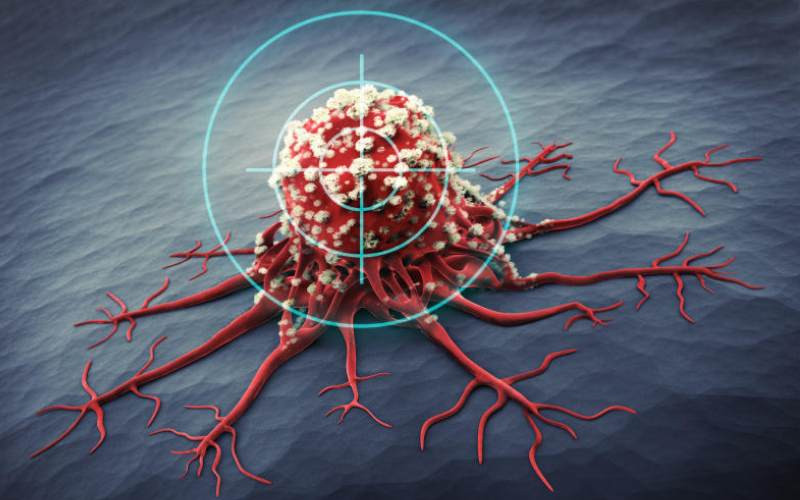
3D Rendering of a cancer cell - medical illustration [iStock]
A sperm donor, who is an asymptomatic carrier of a genetic mutation increasing the risk of cancer, was used to conceive nearly 200 children worldwide, Denmark's public broadcaster revealed Wednesday.
"At least 197 children were born thanks to the sperm of an anonymous Danish donor using the alias Kjeld before the sperm bank discovered a serious genetic abnormality," public broadcaster DR reported.
According to DR, Denmark's European Sperm Bank, one of the largest in the world, was alerted in April 2020 that a child conceived via donation and diagnosed with cancer carried a genetic mutation.
It then tested a sample of the donor's sperm, but the screening did not detect the rare TP53 mutation.
Sales of the sperm, which had been suspended during testing, then resumed.
Three years later, the sperm bank was informed of at least one other child conceived from a donation with the mutation that had developed cancer.
It then tested several samples, which showed that the donor carried the gene, though he was healthy. The use of his sperm was then blocked in late October 2023.
- Kenya hosts breast cancer training as awareness month starts
- I lost my hair and breast, but never my hope: Roseline's cancer victory
- AAR Hospital cuts cancer screening costs
- How breast cancer survivors are turning scars into courage
Keep Reading
Between 2006 and 2022, the man's sperm was sold to 67 clinics in 14 countries. In Denmark alone, 99 children were fathered by the donor.
"The specific mutation is a rare and previously undescribed TP53 mutation that is only found in a small part of the donor's sperm cells and not in the rest of the body, as the donor himself is not affected," the sperm bank said in a statement.
It could not be detected by prior genetic screening, and not all children conceived from the donor have the mutation, the company insisted.
The company says it has been involved in the births of more than 70,000 children worldwide over two decades.
Many European countries have regulations limiting the number of children per donor, but there are no international regulations governing the number of children a donor can father across borders.
At the end of 2022, the European Sperm Bank set a maximum of 75 families per donor.






 join
join