×

The Standard e-Paper
Kenya’s Boldest Voice
 The Standard Group Plc is a
multi-media organization with investments in media platforms spanning newspaper
print operations, television, radio broadcasting, digital and online services. The
Standard Group is recognized as a leading multi-media house in Kenya with a key
influence in matters of national and international interest.
The Standard Group Plc is a
multi-media organization with investments in media platforms spanning newspaper
print operations, television, radio broadcasting, digital and online services. The
Standard Group is recognized as a leading multi-media house in Kenya with a key
influence in matters of national and international interest.

Audio By Vocalize
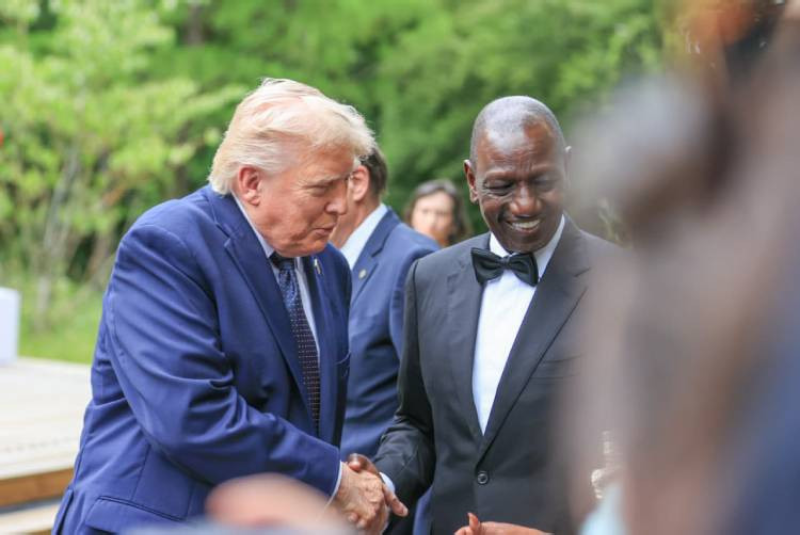
![President William Ruto arriving in Évian-les-Bains, France for the G7 Summit. [PCS]](https://cdn.standardmedia.co.ke/images/wysiwyg/images/8ub73WPHLpG0DQlEMNeaI2XdM7C3cICpsSyBkf5w.jpg)
President William Ruto used two days of G7 summit sessions in France to press world leaders to treat Africa as an equal economic partner rather than an aid recipient.
“Africa is not a problem to resolve. Africa is a task,” said Ruto on Tuesday, June 16, speaking on the sidelines of the Group of Seven (G7) summit in Évian, France.
“Africa is not anybody’s liability,” he added. He said the relationship Africa seeks with the bloc must move beyond handouts. “It is not going to be a relationship about aid, charity or assistance,” noted Ruto, adding, “Extraction is no longer acceptable.”
The president told reporters three summit sessions would cover new international partnerships, a shared development paradigm and technology, including Artificial Intelligence (AI).
On AI, he explained Africa wants to help write the rules of the emerging technological order rather than only consume its products. “Africa is going to be a co-creator. We want to be at the centre of it, to write the rules together,” said Ruto.
He put Africa’s untapped financial muscle at $4 trillion (Sh518 trillion) held in pension funds, insurance resources and central bank reserves, and observed that the continent lacks mechanisms to mobilise the money.
He called on G7 partners to help unlock that capital and said he expected concrete proposals on concessional finance before the summit closes. He also accused global credit rating agencies of exaggerating Africa’s risk profile, a practice he said damages the continent’s economic prospects. “We are not asking for Africa to be treated in a special way,” said Ruto. “We are asking for Africa to be treated equally,” he added.
Ruto returned to the same theme on Wednesday, June 17, addressing a G7+ working session on reviving balanced and shared global growth. “Africa is central to the future of global growth and prosperity,” he told the session.
He noted that six of the world’s fastest-growing economies are in Africa and that one in four people on the planet will be African within 25 years. By 2050, he explained, the continent will hold close to 40 per cent of the global workforce and a market of more than 2.4 billion people. Ruto observed that Africa also holds many of the critical minerals powering electric mobility, clean energy, digital infrastructure and AI, but said decades of raw extraction with little local processing have left the continent without a fair share of that value.
“Let us process our minerals in Africa. Let us manufacture in Africa. Let us build industries in Africa. Let us create jobs in Africa,” said Ruto.
He closed with a direct appeal to the bloc. “My message to the G7 is clear: Pay attention to Africa,” he said.
Kenya was one of five partner countries, alongside Brazil, Egypt, India and South Korea, invited to the summit hosted by French President Emmanuel Macron. The invitation followed a call by African heads of state at the Africa Forward Summit in Nairobi in May for France and Kenya to carry the continent’s position to Évian.
The summit also produced a joint G7 leaders’ statement on a resurgent Ebola outbreak in the Democratic Republic of Congo (DRC) and Uganda, endorsed by Kenya alongside Egypt, India and South Korea.
“We are deeply saddened by the loss of lives and the burden that the disease is inflicting on the affected communities and stand in solidarity with the countries affected,” the leaders said in the statement issued on Tuesday, June 16. The outbreak is centred in an isolated and conflict-affected area of eastern DRC and has spread into Uganda.
Leaders noted that existing vaccines, diagnostics and treatments are not fully effective against the rare strain involved and praised health workers, volunteers and local communities for their response under difficult conditions.
Stay informed. Subscribe to our newsletter
The statement listed financial commitments including more than $370 million (Sh47.9 billion) already deployed by the United States in health and humanitarian resources, with a pledge of up to a further $500 million (Sh64.8 billion) for the Ebola response.
The European Union has put in €493 million (Sh74.1 billion), including €84 million (Sh12.6 billion) in immediate humanitarian aid, while a continental preparedness plan has mobilised $518 million (Sh67.1 billion) to help African countries strengthen surveillance and response systems.
Leaders said containing the outbreak depends on contact tracing, infection control, quarantine measures, laboratory testing, border surveillance and community engagement.
They flagged the coming months of mass international travel, including for the FIFA World Cup in the United States, Canada and Mexico, as a reason to align travel and quarantine procedures across borders while respecting national sovereignty. They also tied the health response to the wider conflict in eastern DRC, calling on all parties to honour commitments under the Washington Accords for Peace and Prosperity and the Doha Framework.
The United States said it would convene a meeting of G20 foreign ministers to secure broader financial support for the response. For Kenya, the endorsement reflects Nairobi’s growing role in regional disease surveillance and its position as a transport and trade hub in East Africa.
Subscribe to our newsletter and stay updated on the latest developments and special offers!







 join
join